

Cart
0
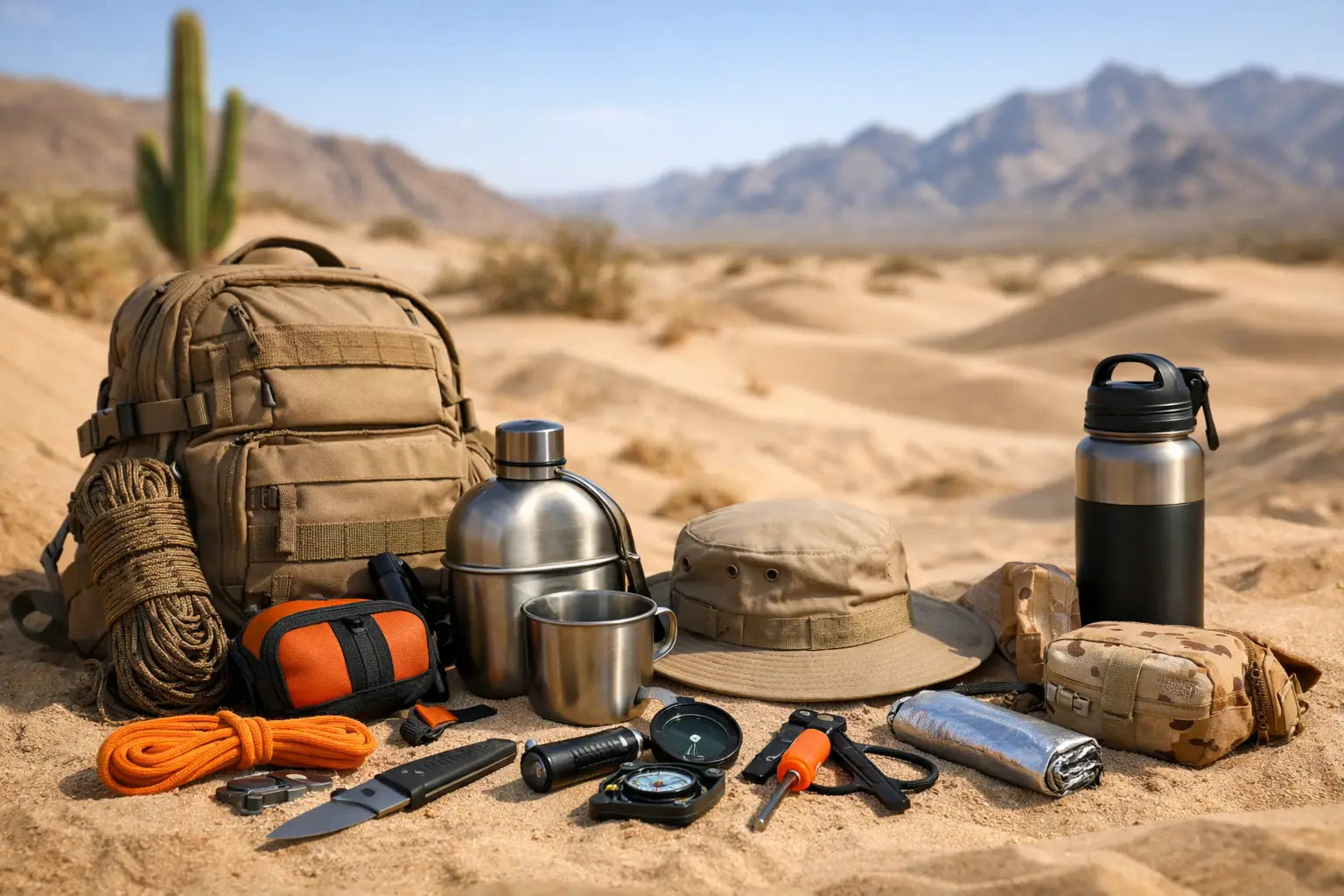
The wrong gear fails fast in the desert. Water runs out, cheap plastic warps in a hot vehicle, batteries drain, and small mistakes turn into real problems when you're miles from pavement. A solid desert survival kit list is not about packing more stuff. It is about carrying the right gear for heat, sun, distance, and breakdowns.
If you spend time hiking, overlanding, camping, shooting, or traveling back roads in Arizona and the Southwest, your kit needs to match the terrain. Desert conditions punish gear that works fine somewhere else. Heat, dust, sharp rock, long exposure, and poor cell coverage change what matters.
What a desert survival kit list needs to do
A useful kit covers five jobs: keep you hydrated, protect you from heat and sun, help you navigate or signal, handle minor injuries, and buy you time if your vehicle breaks down or your route changes. That sounds simple, but the details matter.
For example, a lightweight day-hike kit is not enough for a truck-based trip on remote desert roads. On the other hand, hauling a giant tote of random supplies into the field is not smart either. The best setup depends on whether you are on foot, in a UTV, in a truck, or moving between all three.
Start with the assumption that delays happen. Tires fail. Trails wash out. GPS can get you close but still leave you in the wrong drainage or on the wrong spur. A good kit is built around time. You are not just preparing for a short outing. You are preparing for an unplanned night, a long wait for help, or a hot walk back to a known route.
Water comes first on any desert survival kit list
If there is one place not to cut corners, it is water. In desert travel, hydration is not a comfort item. It is the center of the whole kit.
Carry more water than you think you will need, and store it in more than one container. A hydration bladder is convenient while moving, but it should not be your only source. Bladders can leak, hoses can fail, and heat exposure takes a toll. Hard bottles, insulated bottles, and dedicated water storage in your vehicle add redundancy.
Electrolytes matter too, especially in high heat or during long exertion. Water alone may not be enough if you are sweating hard for hours. Pack electrolyte drink mixes or tablets that store well in heat. They take up almost no space and help you recover faster.
Water treatment is worth carrying, but keep expectations realistic. In many desert areas, natural water sources are scarce, seasonal, or questionable. A filter or purification tablets are backup tools, not a plan. If your route has no reliable water, your kit needs to reflect that.
Shade, sun protection, and heat management
A lot of people think survival means moving hard and covering ground. In desert heat, that can be the wrong call. Often the better move is to create shade, reduce water loss, and wait for cooler conditions.
Your kit should include a way to make shade quickly. A compact tarp, emergency bivy, reflective blanket, or lightweight shelter panel can make a major difference when there is no natural cover. The better option depends on your vehicle space and how mobile you need to stay. A foil emergency blanket is small and cheap, but it is noisy, tears easily, and is not ideal as a stand-alone shelter. A sturdier tarp takes more room, but it is much more useful.
Clothing is part of survival gear too. Long sleeves, lightweight pants, a wide-brim hat, and a neck gaiter can outperform minimal clothing in direct sun. Breathable fabrics help, but the real goal is coverage without trapping too much heat. Sunscreen belongs in the kit, but relying on sunscreen alone is not enough for full-day exposure.
Cooling towels and misting options can help, but they are support items, not essentials. If space is tight, prioritize shade, coverage, and water first.
Navigation and signaling gear you can trust
Desert terrain can look open and simple until every wash, ridgeline, and dirt road starts to look the same. Navigation tools should not depend on a single phone app and a half-charged battery.
Carry a charged phone, but back it up with a paper map of your area and a compass. If you use GPS devices or offline mapping, bring power banks and charging cables that can handle heat and dust. Store electronics where they are not baking on the dash all day.
For signaling, a whistle, signal mirror, flashlight, and high-visibility marker panel all earn their place. Headlamps are often better than handheld lights because they free up both hands. Choose models with dependable runtime and simple controls. In the desert, night comes with rough footing, cactus, and terrain that looks flatter than it is.
If you travel remote enough that self-recovery is not always realistic, a satellite communicator or emergency beacon moves from nice-to-have to serious insurance. Not everyone needs one for every outing, but for solo travel or deep backcountry routes, it is hard to argue against.
First aid that fits desert use
A basic first aid kit is fine for scraped knuckles and small cuts, but desert travel adds a few specific concerns. Heat illness, dehydration, blisters, punctures, eye irritation, and minor trauma from slips or vehicle work are common enough that your kit should account for them.
Stock the basics: bandages, gauze, tape, antiseptic wipes, gloves, tweezers, pain relief, and blister treatment. Then add what matches the terrain and your activity. Eye wash or saline helps when dust and grit become a problem. Burn gel can be useful around hot metal, stoves, and intense sun exposure. An elastic wrap earns its keep for ankle issues on uneven rock.
If you carry advanced medical gear, make sure you know how to use it. Extra equipment is not helpful if it adds bulk without real capability. Practical beats impressive every time.
Repair and recovery items matter more than people think
A desert survival kit list should not stop at personal gear. In the Southwest, many survival situations start with a disabled vehicle.
For vehicle-based travel, carry a tire repair kit, portable air compressor, jumper solution, basic hand tools, duct tape, zip ties, work gloves, and recovery gear matched to your vehicle. That might mean a tow strap, traction boards, shackles, or a shovel. The exact setup depends on whether you are driving maintained dirt roads or deep sand and rock.
Fuel range matters too. Running low is not just inconvenient when the nearest station is far outside your route. Extra fuel storage may be worth it on longer runs, but only if it is stored safely and legally. If you are adding weight and bulk, there needs to be a clear reason.
For non-vehicle kits, a multi-tool, fixed-blade knife, cordage, and durable tape cover a lot of small failures. They are not glamorous, but they solve real problems.
Food, fire, and what can wait
Food matters less than water in the short term, but it still has a place. Pack heat-stable calories that do not melt, spoil fast, or turn into a mess in a hot cab. Bars, jerky, nuts, and simple ration-style foods work well enough. Pick items you will actually eat.
Fire is more situational in the desert than people assume. In cold desert nights, fire can help with warmth and morale. In extreme dry conditions or high-risk fire restrictions, starting one may be unsafe or illegal. Carry multiple ignition sources if your area and season make sense, but do not treat fire as your primary answer to desert survival.
Keep the kit organized and terrain-specific
The best desert kit is the one you can reach fast. If your medical gear is buried under cooking gear and straps, that is a problem. If your water is spread across three bags and a rear drawer system, that is a problem too.
Organize by function. Keep hydration, medical, navigation, and signaling gear easy to access. Store backup supplies separately so one damaged bag does not take out everything important. Dust-resistant pouches, hard cases for fragile items, and clear labeling save time when things go sideways.
It also helps to build in layers. Your on-body or day-pack kit should cover immediate needs if you leave the vehicle. Your vehicle kit should support longer delays and recovery. Those are related, but they are not the same setup.
A practical desert survival kit list for real use
A complete desert survival kit list usually includes water storage, electrolyte support, sun-protective clothing, sunscreen, shade or shelter material, navigation tools, lighting, signaling tools, first aid, repair supplies, a cutting tool, cordage, food, and vehicle recovery gear where needed. The exact mix changes with distance, season, and how much you rely on your vehicle.
That is the trade-off most people miss. More gear is not always better. Better-matched gear is better. A compact, well-built kit that handles Arizona heat, dust, and remote travel beats a bulky bin of generic supplies every time.
If you are building or upgrading your setup, think like the desert does. It strips away extras and exposes weak points fast. Start with water, shade, navigation, and repair, then build from there with gear that can actually handle the miles ahead.

