

Cart
0
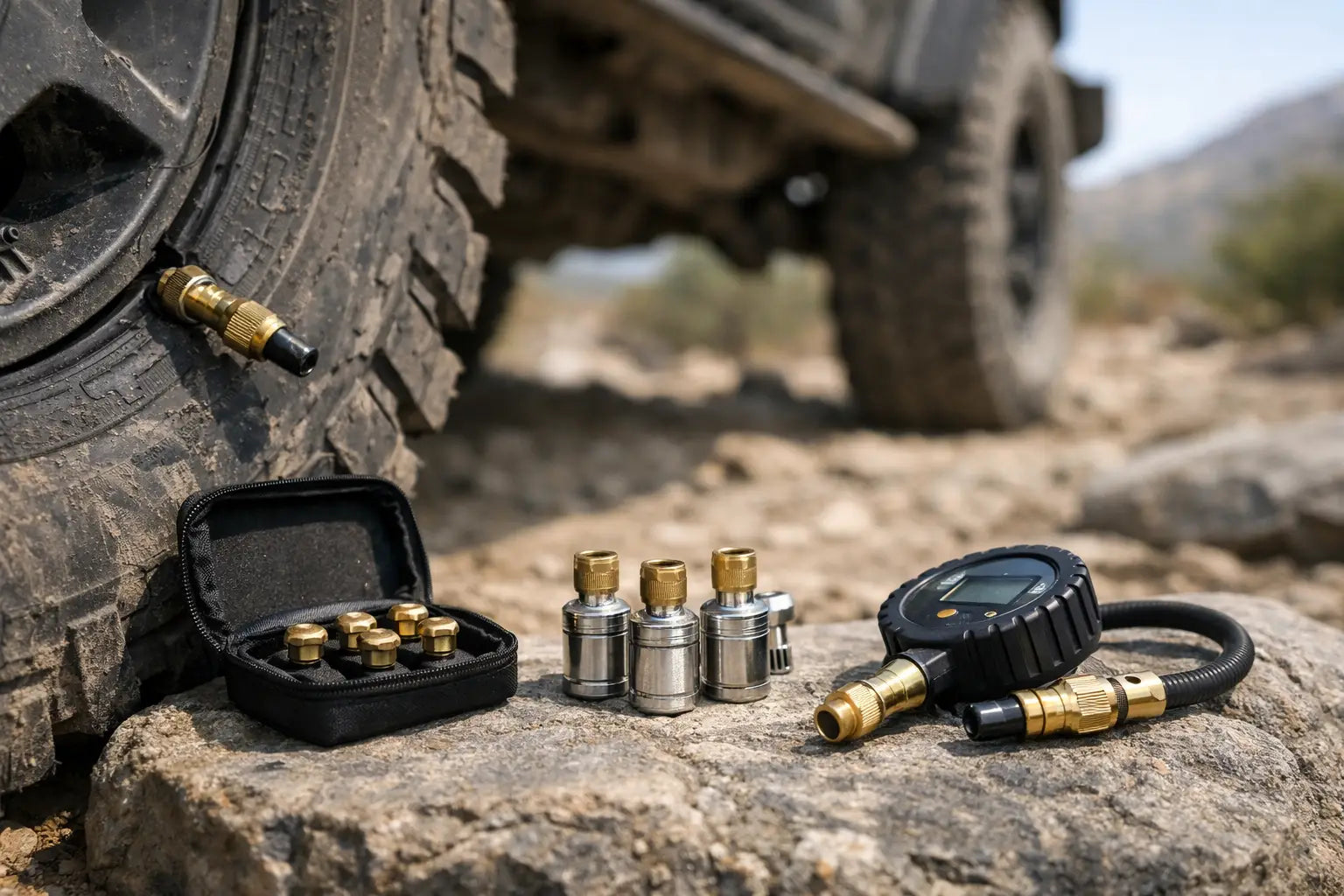
You feel the difference as soon as the trail turns loose and choppy. A truck at street pressure skips across washboard, fights for grip in sand, and beats up both driver and suspension. That is where offroad tire deflators earn their place in your kit. They let you air down quickly and consistently, which matters when you are trying to get better traction, a smoother ride, and more control in desert terrain.
For Arizona and the wider Southwest, this is not a small convenience item. It is one of those tools that saves time at the trailhead and helps your vehicle work with the terrain instead of against it. If you run rocky two-tracks, soft sand, dry riverbeds, or long corrugated roads, a good set of deflators makes the whole process faster and more repeatable.
Why offroad tire deflators matter
Airing down increases the size of the tire’s contact patch. In plain terms, more rubber meets the ground. That usually means better traction on loose surfaces and less harshness over rough sections. In sand, it can be the difference between floating over the top and digging in. On washboard roads, it helps calm the vehicle and reduces the constant chatter that wears you out over miles.
The trade-off is simple. Lower pressure is for lower-speed terrain use, not highway driving. If you air down to improve trail performance, you also need a reliable way to air back up before you head home. Deflators are only half the system. The other half is a compressor that can handle your tire size and vehicle weight.
There is also a practical point many drivers learn the hard way. Letting air out by hand with a valve stem tool works, but it is slow and inconsistent. One tire ends up at 17 psi, another at 21, and now the vehicle feels uneven. Offroad tire deflators solve that by speeding up the process and making the target pressure easier to hit across all four tires.
The main types of offroad tire deflators
Not all deflators work the same way. The right choice depends on how often you air down, how precise you want to be, and how much time you want to spend kneeling by the tires in the sun.
Preset automatic deflators
These are the most popular option for regular trail use. You thread them onto each valve stem, and they automatically release air until they reach a preset pressure. Once dialed in, they are fast and convenient. You can install all four and let them work at the same time while you do a quick walkaround, check your gear, or plan your route.
Their biggest advantage is consistency. If the set is adjusted correctly, each tire will stop near the same pressure. That is a big improvement over guessing or bleeding air one tire at a time. For drivers who air down often, automatic deflators usually make the most sense.
The downside is setup. Cheap sets can be finicky to calibrate, and lower-end models may not stop as accurately as advertised. Dust, wear, and poor machining can also affect long-term reliability. In desert conditions, where fine grit gets into everything, build quality matters.
Manual deflators with built-in gauge
These tools remove the valve core or press the valve to release air quickly while showing pressure on a gauge. They are slower than a four-corner automatic setup, but they give you direct control. If you like checking each tire yourself and adjusting pressure based on load, terrain, or sidewall stiffness, manual deflators are a solid option.
They also make sense for drivers who do not air down every trip. You get one compact tool, decent precision, and fewer moving parts to keep track of. The trade-off is time. When it is 105 degrees at the trailhead, the appeal of a faster system becomes obvious.
What to look for before you buy
The best deflator is not the one with the most features. It is the one that works reliably, survives trail conditions, and matches how you actually use your vehicle.
Start with pressure range. Most off-road drivers are not dropping to extreme numbers on every trip. A midsize truck in rocky desert terrain may only need to come down into the high teens or low 20s, while deeper sand may call for lower pressure depending on tire construction, wheel size, load, and driving style. Your deflators should be easy to set within the range you actually use.
Gauge quality matters too, especially with manual tools. A vague or low-quality gauge defeats the purpose. You do not need laboratory precision for trail use, but you do need readings you can trust. If your target is 18 psi, being consistently close matters more than chasing perfection.
Materials are another big factor in the desert. Brass and stainless components generally hold up better than flimsy mixed-metal hardware. Threads should be clean, seals should feel secure, and small parts should not seem easy to strip or lose. Heat, dust, and repeated use will expose weak construction fast.
Storage is easy to overlook until you are crawling around the cab looking for one missing piece. A compact case with labeled slots is worth having, especially for automatic sets. Small trail tools disappear quickly in center consoles, recovery bags, and door pockets.
Choosing the right pressure for your terrain
This is where experience matters more than marketing. There is no universal number that works for every rig.
On rocky desert trails, many drivers air down enough to improve ride quality and grip without risking excessive sidewall flex or wheel damage. In soft sand, the goal is usually more flotation, which often means going lower. Heavier vehicles, loaded overland builds, and trailers change the equation. So do tire load ratings, wheel diameter, and sidewall construction.
The safe approach is to treat pressure as vehicle-specific. Start conservatively, test how the vehicle responds, and adjust with purpose. If steering feels vague, the tire looks too rolled over, or you are risking bead issues, you may have gone too low for the setup. If the vehicle is still harsh and skittish over rough terrain, you may not have gone low enough.
Good offroad tire deflators help here because they make repeatable testing easier. Once you figure out that a certain pressure works for your truck on a certain type of trail, you can return to it without wasting time.
Common mistakes with tire deflators
The first mistake is assuming any deflator is accurate right out of the package. Automatic sets usually need adjustment and verification. Before trusting them on a trip, test them with a known good gauge and make sure all four are stopping where they should.
The second mistake is ignoring valve stem condition. If your stems are worn, damaged, or packed with debris, threading on deflators can become frustrating fast. A quick inspection before a trip saves hassle.
The third mistake is forgetting the full air-down and air-up process. Deflators without a compressor plan leave you stuck at trail pressure when it is time to hit pavement. That is not just inconvenient. It is hard on tires and unsafe at speed.
Another common issue is buying for price alone. Bargain deflators can work, but this is one of those categories where poor machining, weak seals, and inconsistent performance show up quickly. If you air down more than a few times a year, reliability is worth paying for.
When automatic deflators are worth it
If you run trails regularly, automatic deflators usually justify themselves quickly. They save time, reduce hassle, and make pressure more uniform across all four tires. That matters on vehicles where balance and consistency affect handling over long rough sections.
They are especially useful for group trips and changing conditions. When everyone wants to get moving before the heat climbs, faster setup helps. In places like Arizona, where trail days often start early to beat the sun, cutting ten or fifteen minutes from the air-down routine is not nothing.
Manual tools still have a place, especially for occasional users or drivers who want one compact piece of gear. But if off-road travel is a regular part of your weekends, a dependable automatic set is often the more practical call.
Building a better tire setup around deflators
Deflators work best as part of a simple, dependable system. That means a quality gauge, a compressor with enough duty cycle for your tires, valve caps that stay in place, and a storage pouch where you can find everything without digging. None of this is complicated, but every piece helps when you are airing down in blowing dust or airing up at the end of a long day.
Arizona Desert Gear serves a customer base that knows the value of gear that earns its keep. Off-road accessories do not need to be flashy. They need to work in heat, dirt, and repeated use. Tire deflators fit that standard when they are built well and matched to the way you travel.
The best tool is the one that gets used, and offroad tire deflators are a good example. Pick a set that fits your terrain, verify its accuracy, and keep it with your air-up gear. When the road turns to sand, rock, and washboard, you will be glad the job takes minutes instead of guesswork.

