

Cart
0
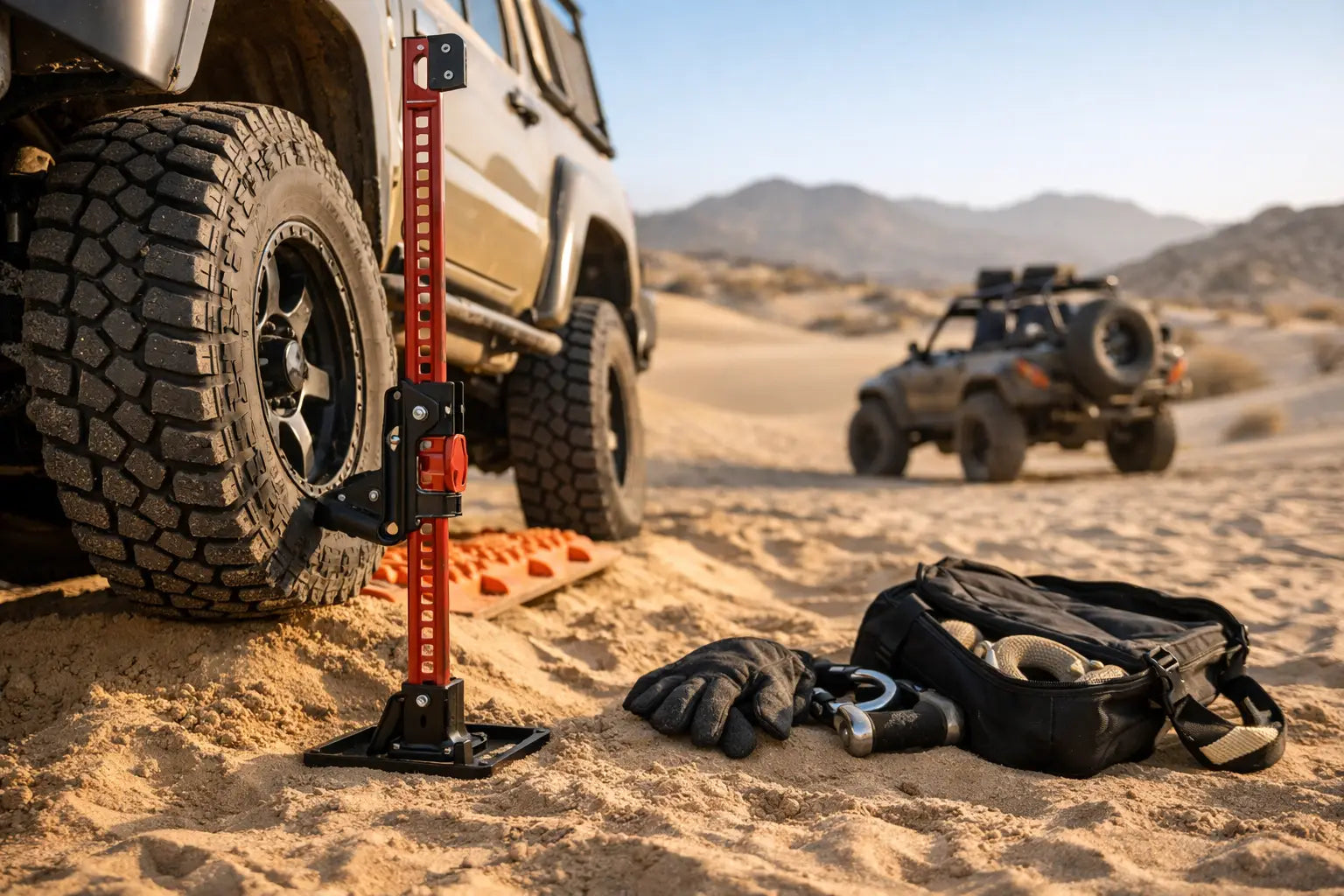
A flat tire on a graded road is an inconvenience. A flat tire on a tilted shelf road, in loose sand, or miles past the last Arizona gas station is a recovery problem. This off road jack review focuses on what matters when the ground is hot, soft, uneven, and far less forgiving than a driveway: lifting height, base stability, load control, storage, and the ability to work when dust has found its way into everything.
The short answer is that no single jack is right for every rig or trail. A properly sized hydraulic bottle jack is the best all-around choice for many 4x4s. A Hi-Lift-style farm jack earns its place on equipped vehicles that need extra reach or can use it for recovery work. A floor jack is excellent around camp or at home but usually a poor choice for remote travel. Air jacks can work in sand and mud, but they demand careful handling and a clean setup.
What an off road jack must do
A jack does not need to lift the whole vehicle. It only needs to raise one tire far enough to clear the ground after suspension droop. That detail catches people off guard. A lifted Jeep, truck, or SUV can require a surprising amount of lift before the flat tire comes off the dirt.
Start with the rig, not the product label. Check your vehicle's loaded weight, safe factory lift points, wheel and tire size, suspension lift, and the height of the axle or frame where you intend to lift. Then account for terrain. Sand, decomposed granite, and sun-baked wash bottoms all let a narrow jack foot sink or shift under load.
For desert travel, a capable jack needs a wide base or a separate base plate, enough lift range for your suspension, and a way to stay secured in the vehicle without becoming a loose projectile on rough roads. It should also be simple enough to operate when you are tired, dusty, and working in bad light.
Off road jack review: the main types
Hydraulic bottle jacks
A bottle jack is compact, strong, and generally the most sensible off-road tire-change jack for a truck, SUV, or properly equipped 4x4. Good models pack easily in a recovery bag or tool drawer and can lift from an axle tube or another manufacturer-approved point. Their low storage footprint is a major advantage when water, tools, medical supplies, and recovery gear are competing for cargo space.
The trade-off is starting height and usable lift. A tall bottle jack may not fit under a low axle or control arm when the tire is fully flat. A short one may run out of stroke before the wheel clears. Carrying solid blocking can solve both problems: use a stable base under the jack when needed, and build height beneath the axle only after the vehicle is safely stabilized.
Bottle jacks also dislike side loading. Keep the jack as vertical as possible, use a base plate on soft ground, and do not improvise with stacked rocks, brittle wood, or loose pavers. Heat can make hydraulic equipment uncomfortable to handle, but it is usually dust contamination and neglected seals that cause trouble over time. Store the jack clean and check it before every trip.
Hi-Lift-style farm jacks
The Hi-Lift is popular because it offers serious lift height and can do more than lift. With the correct accessories and training, it can assist with winching, clamping, and repositioning. For a vehicle with steel bumpers, rock sliders designed as lift points, or dedicated jack points, it can be a useful recovery tool.
It is also one of the least forgiving tools in the kit. A loaded farm jack stores energy, and the handle can kick violently if control is lost. The tall lifting range exaggerates vehicle movement, especially on side slopes or loose terrain. Plastic bumpers, thin sheet metal, and unprotected factory rocker panels are not safe lifting points.
Treat this jack as a specialized tool, not a universal answer. It makes sense for a built trail rig with compatible recovery points and an owner who has practiced with it on level ground. For a stock daily-driven SUV, a bottle jack plus a stable base is usually safer and easier to use.
Floor jacks
A floor jack is hard to beat for stability on a flat concrete pad. It rolls smoothly, lifts with little effort, and works well for garage maintenance, pre-trip inspections, and repairs at a developed campsite with firm ground. If your off-road vehicle is frequently serviced at home, a quality floor jack is worth owning.
It is not the right primary jack for backcountry travel. Floor jacks are bulky, heavy, and dependent on a hard, level surface. Their small wheels sink in sand and catch on rocks. Even compact models eat up cargo room and add weight where it matters. Keep a floor jack in the garage, not as your only plan for a remote trail repair.
Exhaust and air jacks
Inflatable air jacks spread load across a broad area, making them appealing in deep sand, mud, or snow. They can lift a vehicle without placing a narrow metal foot directly into soft terrain. That broad contact patch is their strongest advantage.
Their limits are real. Sharp rocks, cactus spines, hot exhaust components, and abrasive ground can damage the bag. Placement requires care, and the vehicle must be secured against rolling before inflation begins. Exhaust-powered versions also require an engine and a properly managed connection. These are useful tools for certain terrain, but they are not the simplest choice for a first recovery kit.
Stability matters more than rated capacity
A 6-ton rating sounds reassuring, but capacity alone does not make a jack safe. Most off-road vehicles are lifted one corner or one axle at a time, so the actual load is below total vehicle weight. The more relevant question is whether the jack remains stable at the required height on the surface beneath it.
Carry a purpose-built jack base, a thick composite board, or a dense hardwood block with a broad footprint. The base should be large enough to resist sinking and thick enough not to crack under load. A board that works on driveway gravel may disappear into dry wash sand.
Before lifting, place the transmission in park or in gear as appropriate, set the parking brake when the axle being lifted allows it, and chock the wheels that remain on the ground. On a steep or unstable trail, moving the vehicle a few feet to firmer, flatter ground is often the smartest recovery decision. Do not rush a tire change because the trail looks exposed or the sun is dropping.
Match the jack to your lift point
Your owner's manual should guide factory lift points. Many off-road drivers lift from a solid axle because it reduces how far the suspension must extend before the tire leaves the ground. Independent suspension vehicles may need a different approach, so verify the correct point for your specific platform.
Do not put a jack under a differential cover, steering linkage, skid plate, thin control arm, or a random section of frame simply because it looks convenient. Use an adapter only when it is designed for the jack and lift point. A slipping adapter can turn a manageable repair into vehicle damage or an injury.
Once the tire clears, place a rated jack stand or stable blocking under an appropriate support point if you need to work beyond a quick wheel swap. Never put any part of your body under a vehicle supported only by a jack. A trail jack is for lifting, not for holding a vehicle while you troubleshoot suspension or drivetrain damage.
A practical desert jack kit
For most Arizona and Southwest overland rigs, the useful setup is a quality bottle jack with adequate capacity and stroke, a wide base plate, a short extension or lifting pad where appropriate, wheel chocks, a breaker bar, a torque wrench, gloves, and a tire repair kit. Add solid blocking if your vehicle's lift height requires it.
A farm jack belongs in that kit only if your bumpers, sliders, or dedicated lift points are made for it and you are willing to practice. An air jack makes more sense for drivers who regularly deal with deep sand or soft terrain and understand its placement limits. The best off-road jack is the one that fits your vehicle, reaches the correct lift point, and can be operated safely on the ground you actually travel.
Before your next desert run, test the full setup at home with the same tires, cargo load, and lift points you will use on the trail. A few minutes of practice in the shade is far better than learning what does not fit when you are stranded on hot sand with daylight running out.

