

Cart
0
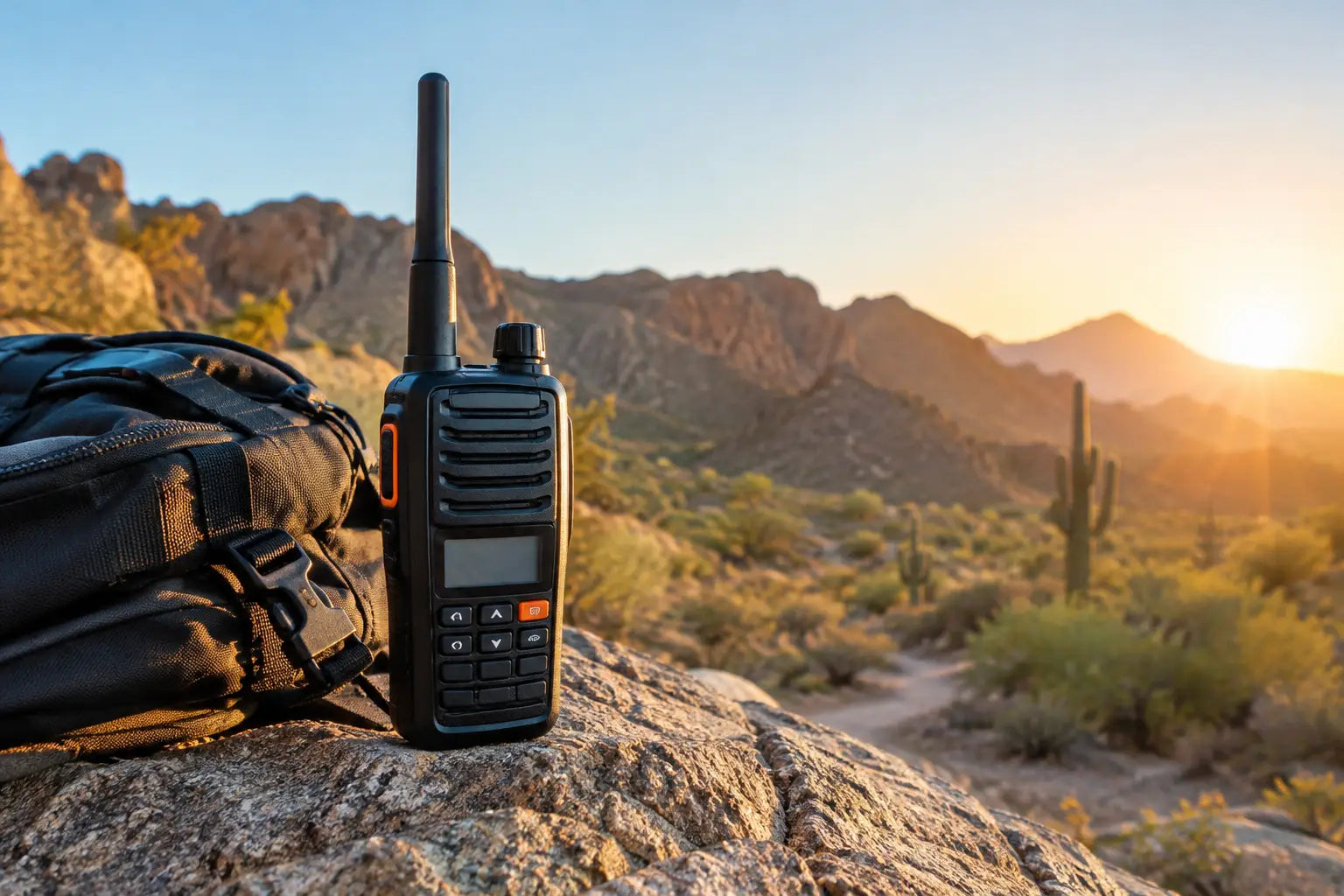
A dead cell signal outside Wickenburg is inconvenient. A failed radio when your lead vehicle takes the wrong wash, someone gets a flat, or a recovery is underway is a real problem. This offroad radio review looks at the communication options that make sense for desert drivers, overlanders, side-by-side crews, and trail groups that need dependable contact beyond pavement.
The right radio is not automatically the one with the biggest advertised range or the most buttons. In Arizona and the broader Southwest, heat, dust, loose wiring, terrain shadows, and long distances punish poorly chosen equipment. A useful trail radio needs clear audio, a practical power setup, an antenna matched to its band, and controls you can operate without taking your attention off the trail.
What an Offroad Radio Must Handle in the Desert
Desert travel creates communication problems that do not show up in a parking-lot test. Line of sight can disappear the moment one vehicle drops into a wash or climbs behind a ridge. Long open flats may provide excellent range, but rocky terrain, heavy brush, and canyon walls can cut it quickly. That is why advertised maximum range should be treated as a best-case number, not a field guarantee.
Heat matters too. A radio mounted directly in sunlight can become difficult to read, hard to handle, and more likely to shut down under extended transmission. Choose a mounting position with airflow and shade where possible. Dust protection is equally practical. A radio body may survive a dusty cab, but exposed microphone ports, loose accessory plugs, and cheap switches often become the weak points.
For vehicle-mounted systems, a clean 12-volt connection is better than relying on a cigarette-lighter plug. Hardwiring with an appropriately fused lead reduces accidental disconnects on rough roads. It also lets the radio deliver its intended output without sharing power with a cooler, air compressor, lights, and other accessories.
Offroad Radio Review: GMRS Is the Best Fit for Most Groups
For most recreational off-road groups, GMRS is the strongest all-around choice. It is widely used by overlanders, Jeep clubs, UTV riders, and family trail crews because it combines simple operation with the potential for useful vehicle-to-vehicle range. A handheld GMRS radio works for spotters, hikers, and passengers, while a mobile unit with an external antenna is the better choice for the lead, sweep, or any vehicle that regularly travels remote routes.
GMRS has a licensing requirement in the United States, but no exam is required. One license covers the holder and qualifying family members, which makes it manageable for many households. Every person in a larger trail group does not need to be under the same license, however, so make sure your group understands the rules before relying on GMRS as its standard.
The real advantage of a mobile GMRS setup is not just transmit power. It is the antenna. A properly installed exterior antenna mounted high and clear of metal obstructions will generally outperform a handheld radio inside a vehicle, even when both are set to the same channel. In a four-wheel-drive truck with a steel roof or rack, antenna placement needs extra thought. Mounting low behind a spare tire or next to multiple steel accessories can limit performance in certain directions.
GMRS is not magic. In steep canyons or behind major terrain features, it can still lose contact. But for convoy spacing, route calls, hazard warnings, and coordinating a recovery, it is usually the best balance of capability and simplicity.
VHF and UHF: Better When Your Group Has a Plan
Amateur radio equipment can offer excellent range, flexible programming, and access to repeaters, but it is not the casual answer for every trail group. Using amateur frequencies requires an amateur radio license, and each operator needs their own license. That makes it a strong option for prepared, radio-minded users, not a shortcut for unlicensed group communication.
VHF often performs well across open desert terrain and can be a sensible choice for vehicles spread across broad valleys. UHF is commonly effective in closer, more cluttered environments and is popular for many local repeater networks. Which one performs better off-road depends heavily on terrain, antenna setup, and the repeaters available where you travel.
A dual-band mobile radio can be valuable for drivers who already hold an amateur license and want trail communication plus emergency monitoring options. The trade-off is complexity. Programming channels, understanding band plans, and using repeaters correctly takes more preparation than setting a GMRS channel and performing a radio check at the trailhead.
CB Radio Still Has a Place, but Know Its Limits
CB remains common enough that it can be useful, especially around highway traffic, older four-wheel-drive groups, and some organized trail events. It does not require an individual license, and the equipment is familiar to many drivers. If your regular group already uses CB, a well-installed unit is more useful than buying a different system nobody else monitors.
Still, CB has compromises. Antenna tuning is more critical than many buyers realize, and a poorly tuned antenna can hurt performance or damage the radio. CB antennas are also longer and less convenient to mount than many GMRS antennas. Noise from vehicle electronics can be another issue, particularly in newer vehicles with charging systems, accessory lighting, and multiple electronic modules.
CB is workable for short-range convoy communication. It is less attractive as the first choice for a new desert trail setup unless compatibility with an existing group is the main concern.
Handheld or Mobile Radio?
A handheld radio is easy to pack, easy to lend, and useful outside the vehicle. It belongs in every serious trail kit, even if your primary system is vehicle-mounted. A passenger can use it to spot through an obstacle, a hiker can carry it away from camp, and it provides backup if the main radio loses power.
But handhelds have limits inside a vehicle. The metal body of a truck, Jeep, or SUV can reduce their range, and their small antennas do not have the height or efficiency of a properly mounted external antenna. Battery life also falls faster during long days of active use, especially in high heat.
A mobile radio is the right primary choice for drivers who lead trips, run remote routes, tow trailers, or regularly travel with multiple vehicles. It provides more consistent power, a better microphone, stronger audio, and support for a real external antenna. The downside is installation. Expect to run power safely, choose a protected mounting location, route antenna cable carefully, and avoid pinching coax under doors or through sharp metal edges.
Features Worth Paying For
A radio does not need a touchscreen or a long feature list to work well on a trail. It does need controls that make sense when the vehicle is bouncing and the cab is dusty. A large volume knob, readable screen, solid microphone connector, and simple channel controls are more useful than menus buried behind tiny buttons.
Look for adjustable squelch, weather-channel receive capability where available, programmable memory channels, and a strong mounting system. A detachable faceplate can help when dash space is tight, while a remote speaker can make a major difference in loud rigs with mud tires, open tops, or diesel engines.
For handhelds, favor removable batteries, a charging method you can support from the vehicle, and an accessory port for a better antenna or speaker mic. Water resistance is useful, but do not confuse it with dustproofing or heat resistance. Store spare handheld batteries out of direct sun, not on the dashboard.
Antennas Decide More Than the Radio Body
A quality antenna installation can make a mid-priced radio perform better than an expensive unit paired with a poor antenna. Use an antenna designed for the correct frequency band, keep the coax cable intact, and avoid tightly coiling excess cable into a bundle. For GMRS and amateur mobile radios, antenna height generally helps, but the best location also depends on your vehicle and gear layout.
A roof-center mount often provides the most even radiation pattern, but it is not practical for every rig. Bed racks, bumpers, hood brackets, spare-tire mounts, and fender locations all involve compromises. A bumper-mounted antenna may be protected and convenient, yet it can be partially blocked by the vehicle. A tall rack mount may improve height but can catch branches or take abuse on tight trails.
Before a trip, test your setup with another vehicle over real terrain. Do not judge it from a driveway conversation across an empty neighborhood.
The Practical Buy for Most Desert Drivers
For most people building a dependable trail communication setup, start with a mobile GMRS radio, a properly mounted exterior antenna, and one or two handheld GMRS radios for backup and spotting. Add a hardwired power connection, spare charging capability, and a printed channel plan for your group. That setup covers the situations that matter most without turning your cab into a communications console.
If your crew uses amateur radio and every operator is licensed, a dual-band setup may be worth the added learning curve. If your established group runs CB, buy a properly tuned CB rather than forcing everyone to change at once. The best radio is the one your group can use clearly, legally, and without hesitation when conditions turn rough.
Before leaving pavement, agree on a primary channel, a backup channel, call signs or vehicle names, and a simple check-in routine. Good communication starts with reliable gear, but it works because everyone knows what to do when the trail gets quiet.
