

Cart
0
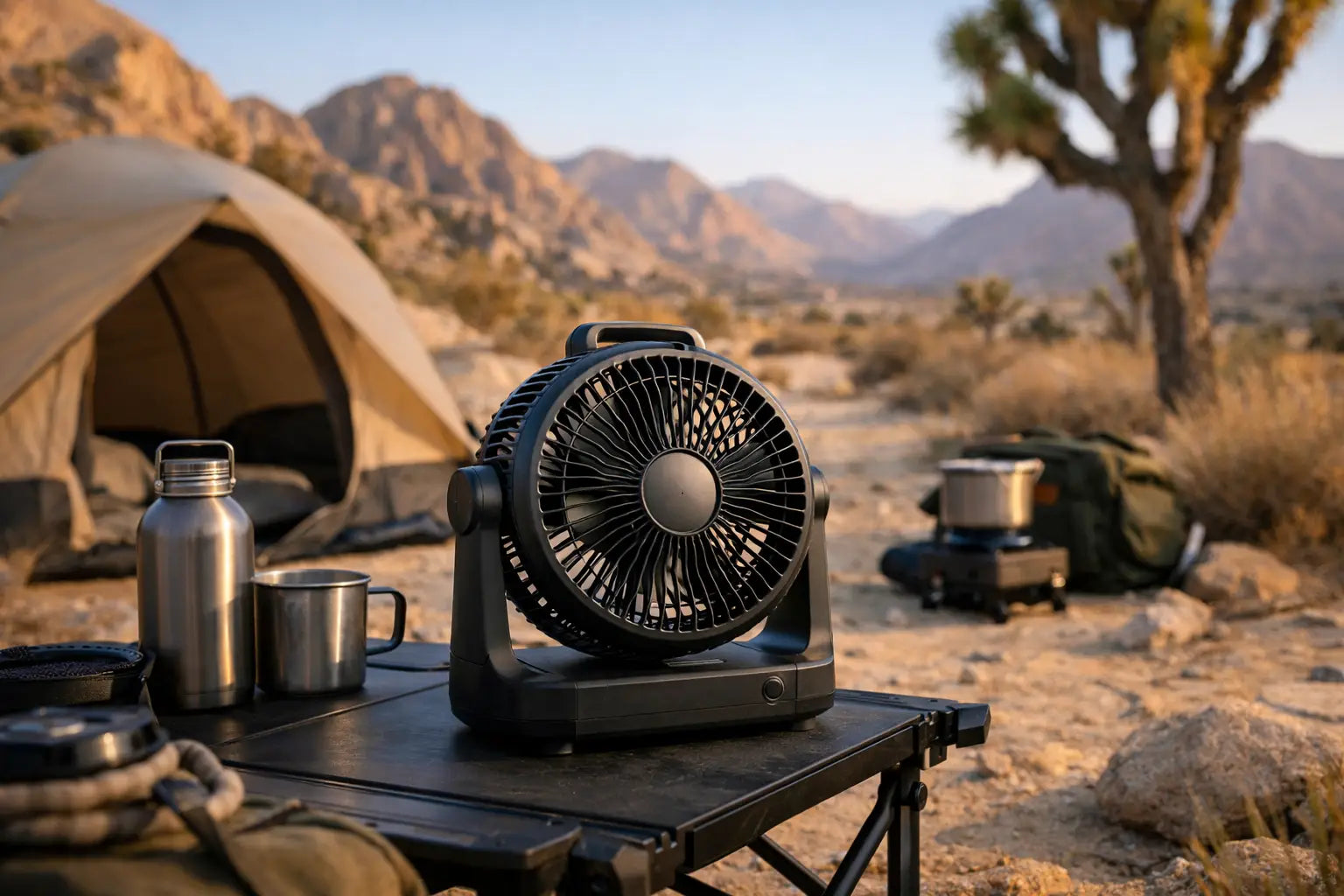
A portable camp fan is easy to dismiss until your tent is still holding 100-degree heat long after sunset. This portable camp fan review focuses on what actually matters for Arizona camping, overlanding, and remote desert stops: usable airflow, honest battery life, secure mounting, and a design that will not quit after a day of dust and heat.
A fan will not replace shade, water, ventilation, or good campsite selection. It can, however, make a tent, RTT, truck bed, or screened shelter far more tolerable when the air is stagnant. The right unit is a practical piece of hot-weather kit. The wrong one is another rechargeable gadget taking up room in your tote.
What a Portable Camp Fan Needs to Do in Desert Heat
The first job is simple: move enough air to matter from a few feet away. Small desktop fans can be quiet and compact, but many only produce a light breeze when placed directly in front of your face. That may be fine at a picnic table. It is not enough to circulate hot air through a two-person tent or keep sweat from pooling during a sleepless night.
Look for multiple speed settings rather than one high-output mode. A good low setting provides steady overnight airflow without draining the battery or turning your shelter into a wind tunnel. A stronger middle setting is usually the workhorse setting for late afternoon camp setup, cooking under an awning, or sitting inside a parked vehicle while it cools down.
High mode matters too, but it should not be the only setting that feels useful. If a fan needs maximum power to produce meaningful airflow, expect short runtime and more noise. For desert use, controlled airflow beats impressive-looking specs on the box.
Battery Runtime Is More Than a Marketing Number
Runtime claims are often based on the lowest speed, sometimes with lights off and no phone charging. Read them as a best-case figure, not a promise. A fan advertised for 20 or 30 hours may run all night at low speed, but only last several hours when used at the speed you actually want.
For most campers, the practical target is one full night of operation on low or medium. If you regularly camp away from shore power for several days, choose a fan with enough battery capacity to avoid daily charging or pair it with a dependable power bank or vehicle charging setup.
USB-C charging is the simplest choice for current field gear. It lets you use the same cable type as many headlamps, battery banks, and phones. A fan with USB-A charging can still work, but it adds another cable requirement. Replaceable battery systems have appeal for extended trips, although proprietary battery packs can be hard to replace when the product ages.
Do not treat a camp fan as an emergency power bank unless that function is genuinely needed. Reverse charging can be useful for a dead headlamp or a short phone top-up, but it also takes energy away from the fan. In a hot tent, airflow is usually the priority.
Portable Camp Fan Review: Features Worth Paying For
Mounting options make a bigger difference than most buyers expect. A fan sitting on the floor moves air at ankle level and takes up valuable tent space. A built-in hook allows you to hang it from a tent ceiling loop, awning crossbar, cargo net, or vehicle grab handle. That position circulates air better and keeps the unit out of the way.
A strong clamp is equally useful, especially for truck-bed camping, trailers, and camp tables. It should grip securely without relying on a fragile plastic spring. For tent use, check the fan's weight. A heavy fan can pull down lightweight mesh pockets or strain small interior loops. The best placement is often overhead or at shoulder height, angled across the sleeping area rather than aimed at one person all night.
An adjustable head is not a luxury feature. It lets you direct airflow where it is needed as the sun moves, people shift seats, or the fan changes from table duty to sleeping duty. A full pivoting head is more useful than a fan that can only tilt slightly upward.
Light Is Helpful, but It Should Not Be the Main Event
Many portable fans include an LED lantern. That is useful for finding gear, reading a map, or getting situated in the tent. It should not replace a dedicated headlamp, and it should not be a reason to accept weak airflow.
Choose a warm or dimmable light if you plan to use it inside a tent. A harsh white light attracts attention, ruins night vision, and makes it harder to settle down. Separate fan and light controls are also preferable. You should be able to run the fan without accidentally cycling through bright lighting modes at midnight.
Noise deserves the same practical approach. No portable fan is silent at full speed. What matters is the character of the sound. A steady hum is easier to sleep through than rattling plastic, clicking controls, or an unbalanced blade that vibrates against a tent wall. Before a trip, run the fan at your intended sleeping speed for an hour at home. If it annoys you in a quiet room, it will be worse after a long day on the trail.
Dust, Heat, and Build Quality
Desert gear gets punished. Fans sit on gritty tables, ride in dusty cargo areas, get handled with sunscreen-covered hands, and may spend hours in a hot vehicle. A camp fan does not need to be military-grade, but flimsy plastics, loose charging-port covers, and exposed control panels are warning signs.
A protected charging port helps keep dust out. So does a case or simple zip pouch when the fan is stored. Avoid packing it loose with cookware, recovery gear, or metal stakes that can crack the grille or damage the blades. If the fan has removable blades or a grille that opens for cleaning, that is a real advantage in dry country where fine dust builds up fast.
Heat also affects lithium battery performance and life. Do not leave a rechargeable fan baking on the dash or on exposed rock during the hottest part of the day. Charge it in the shade when possible, and do not put it away while it is still hot from use. These basic habits matter more than chasing the largest stated battery capacity.
Water resistance is useful for monsoon-season camps and general spills, but do not confuse it with weatherproofing. A lightly water-resistant fan may handle a brief shower. It should not be left outside during a hard storm or hosed off after a dusty trip. Use a soft brush or dry cloth first, then follow the maker's cleaning instructions.
Match the Fan to Your Camp Setup
For a backpacker, weight and pack size usually matter more than maximum airflow. A compact hanging fan with a modest battery can be enough for one person in a small shelter, particularly when paired with good site selection and open ventilation.
For vehicle campers and overlanders, larger battery capacity and mounting flexibility are worth the extra bulk. A fan that can hang from an awning at dinner, clamp to a tailgate during repairs, and move into a rooftop tent at night earns its space. This is where a durable mid-size unit is usually the best fit.
Families and base-camp users may be better served by two smaller fans rather than one oversized model. One can move air in the sleeping area while the other covers the cooking or seating space. Redundancy also matters in remote areas. If one fan is damaged or drained, the trip does not become a miserable night.
At Arizona Desert Gear, the useful test is straightforward: would you still want this fan after a dusty drive, a 105-degree setup, and a night with no campground power? If the answer depends on perfect conditions, it is not field-ready gear.
Common Buying Mistakes
The most common mistake is buying based on claimed runtime alone. The next is choosing a fan with a huge battery but weak airflow, poor mounting, or a charging system that does not match the rest of your gear. Bigger is not automatically better if the fan is too bulky to position where it works.
Another mistake is expecting a fan to cool an enclosed tent. Fans cool people by helping sweat evaporate. They do not lower the actual air temperature in a sealed shelter. Open safe ventilation points, use reflective shade where appropriate, and position the fan to pull fresher evening air across the space.
Finally, do not wait until the trailhead to test it. Charge it, run every speed, test the hook or clamp, and confirm that your power bank can recharge it. A ten-minute check in the garage is better than discovering a failed battery after dark.
Pack a fan that fits your shelter and power plan, then treat it like the heat-management tool it is. When the desert finally starts giving up the day's heat, steady airflow can be the difference between merely enduring camp and getting the sleep needed for tomorrow's miles.

