

Cart
0
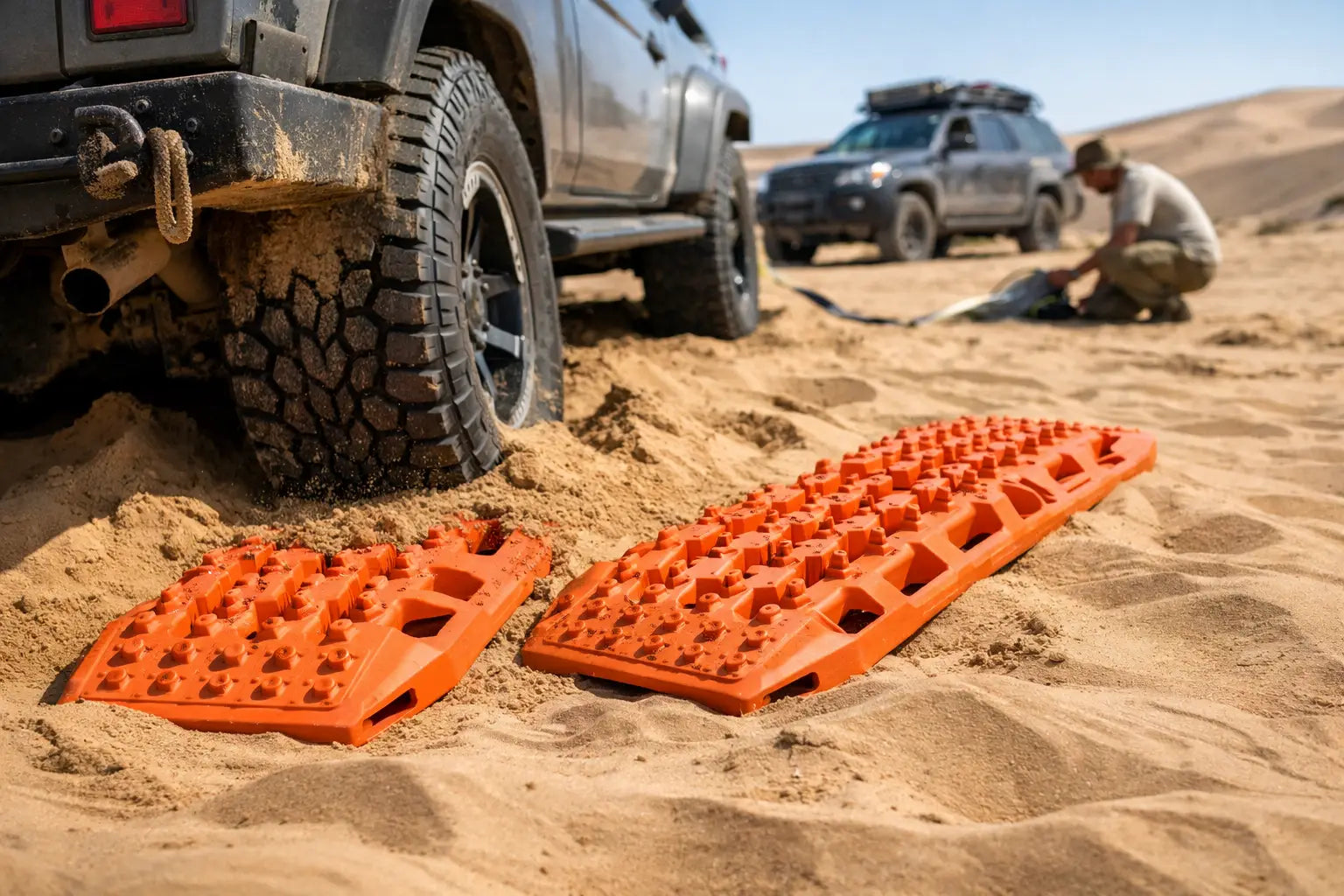
A recovery strap cannot help until your tires have something solid to bite into. That is where a good set of boards earns its space in the vehicle. This vehicle traction boards review focuses on what matters when the trail is loose, hot, remote, and unforgiving: whether boards grip, hold their shape, pack easily, and remain usable after repeated recoveries in desert terrain.
For Arizona two-tracks, dry washes, dune edges, slickrock approaches, and campsites softened by monsoon rain, traction boards are not a novelty accessory. They are a self-recovery tool. Used early, they can save a winch pull, prevent deeper digging, and keep a minor mistake from turning into a long walk for help.
What Traction Boards Need to Do
Traction boards, sometimes called recovery boards or recovery tracks, create a temporary driving surface under a spinning tire. Their raised lugs bite into the tire tread while the underside grips sand, dirt, mud, snow, or uneven ground. The goal is simple: regain forward or reverse momentum without relying on another vehicle.
A worthwhile board needs to do three things at once. It must resist cracking under vehicle weight, provide enough tire engagement to stop useless wheelspin, and flex without becoming permanently bent. Desert drivers should add a fourth requirement: it must tolerate extreme sun and heat when it is mounted outside all season.
No board is indestructible. A heavy vehicle, excessive throttle, sharp rock contact, and an improperly placed board can destroy even premium gear. The useful question is not whether a board can survive every bad decision. It is whether it performs reliably when used correctly, then remains ready for the next recovery.
Vehicle Traction Boards Review: What Separates Good From Cheap
The price spread in traction boards can look excessive until you compare material quality, molding consistency, lug design, and real load behavior. Low-cost boards may look nearly identical in product photos, but the differences show up when a tire is buried to the axle or a hot board is asked to carry a loaded truck.
Material and heat resistance
Most quality boards use reinforced nylon or a similar engineering-grade polymer. These materials flex under load and generally recover their original shape better than brittle plastics. Less expensive boards often use lower-grade plastic that becomes too soft in heat or too prone to cracking when flexed over uneven ground.
For Southwestern use, UV resistance matters as much as advertised weight capacity. A board that lives on a roof rack, exposed to full Arizona sun, should not fade, chalk heavily, or turn brittle after a season. Covered storage inside the vehicle is easier on any polymer, but exterior mounting is common. If the manufacturer offers no clear information about UV stability or operating temperature, treat that as a warning sign.
Lug pattern and tire bite
Aggressive, well-shaped lugs give the tire something to climb. The best patterns have enough height to engage all-terrain and mud-terrain tires without making the board difficult to clean. Broad, rounded lugs tend to spread load and reduce the chance of shaving off sections under throttle. Very sharp, thin teeth can grip hard, but they may wear faster.
The underside also matters. Raised ribs, crossbars, or a textured base help keep the board from skating backward in loose sand. On hard desertpack or slick rock, no underside pattern is magic. Placement and controlled throttle still decide the outcome.
Length, width, and usable surface
Longer boards provide a smoother ramp and more support across a rut. A pair around 45 to 48 inches works well for many SUVs, crossovers, and midsize trucks. Boards in the 50- to 55-inch range offer more surface area for full-size trucks, larger tire diameters, and deeper sand recovery, though they consume more rack space.
Width is often overlooked. A narrow board can work, but it leaves less margin when the tire is angled or the ground is unstable. A wider design supports the tire better and is easier to position under stress. Check the actual usable traction surface, not only the board's overall outside dimensions.
Flex versus stiffness
Some flex is useful. A board that conforms slightly to sand or uneven terrain can keep more of its surface in contact with the ground. Too much flex, however, lets the tire push the board into a U-shape, reducing the ramp effect and stressing the material.
Stiff boards feel reassuring, especially under heavier rigs, but extreme stiffness can transfer force into one spot and lead to cracks. For most overland travel, the best balance is a board that bends under load without folding, then returns close to flat after use.
Choosing Boards for Your Vehicle and Terrain
Match the board to the vehicle you actually drive loaded for travel, not the dry curb weight listed in a brochure. A full-size pickup carrying water, recovery gear, a bed rack, passengers, and camping equipment can be far heavier than expected. The same goes for a four-door Jeep or SUV with armor, drawers, and a rooftop tent.
Manufacturers frequently publish a load rating, but those numbers are not always measured under identical conditions. Use them as a comparison point, not a guarantee. A board supporting a tire on flat sand experiences a different load than one bridging a sharp ledge with the wheels turned.
For a lighter crossover that sees forest roads, beach access, and occasional desert camping, mid-size reinforced boards are usually enough. For a loaded half-ton truck, 3/4-ton truck, or built-out overland rig, prioritize thicker material, a proven molded construction, and a longer board with substantial side rails. Saving a few pounds is not useful if the board fails during the one recovery that matters.
Avoid buying based on color alone. Bright colors are easier to find in sand, sage, or low light, while black boards can look cleaner on a rack. In summer, dark boards also get hotter. Visibility is usually the more practical choice, especially if a board gets buried or left behind at the recovery site.
Real-World Use in Sand, Rock, and Mud
In loose sand, clear enough material from the drive tires to slide each board underneath at a shallow angle. Place the boards in the intended direction of travel, straighten the wheels, and use smooth throttle. Spinning the tires only digs deeper and can chew the lugs off the board.
On rocky terrain, boards can fill a hole, create a small ramp, or protect a tire from a sharp edge. This is a legitimate use, but it is harder on the boards than a sand recovery. Inspect them afterward for deep cuts, cracks around the handles, and permanently distorted sections.
Mud recovery uses the same controlled approach, though mud can make boards slick and heavy. Rinse them before packing them away. Desert users should do the same after clay-rich monsoon mud, which hardens like concrete when left in the lugs and mounting holes.
Never stand in front of, behind, or alongside a board while the vehicle is trying to climb it. A board that catches a tire wrong can launch out from under the vehicle. Keep bystanders clear, use low-range when appropriate, and let the driver focus on a slow, straight exit.
Mounting, Storage, and Maintenance
Exterior mounting is convenient, but it exposes the boards to sun, road grime, theft, and impacts from brush or rock. Use purpose-built mounts that hold the boards tightly enough that they cannot rattle or work loose. Recheck mounting hardware after washboard roads, where vibration finds every weak fastener.
Inside storage protects the boards and keeps them cleaner, but it requires planning. A pair of full-size boards can take up significant cargo room and may carry sand or mud after use. A storage bag or dedicated cargo-side mount keeps the dirty side contained.
Before a remote trip, inspect your boards for damage and make sure you can reach them without unloading the whole vehicle. Carry gloves and a compact shovel with them. The shovel is often what makes board placement possible in the first place.
The Bottom Line on Price and Preparedness
Premium traction boards cost more because better materials, dependable molding, UV resistance, and tested designs cost more to produce. They are a sound choice for frequent off-road travel, heavier vehicles, and anyone who mounts boards outside year-round. Budget boards can still be useful for occasional use, lighter rigs, and drivers willing to inspect them closely and avoid abusive throttle.
At Arizona Desert Gear, the practical standard is simple: buy recovery equipment for the terrain where you will need it, not for how it looks parked at home. A capable pair of boards, a shovel, and patient driving can turn a stuck tire into a short delay instead of a recovery call. Practice placing them before your next remote run, when the sand is dry, the daylight is good, and the pressure is low.

