

Cart
0
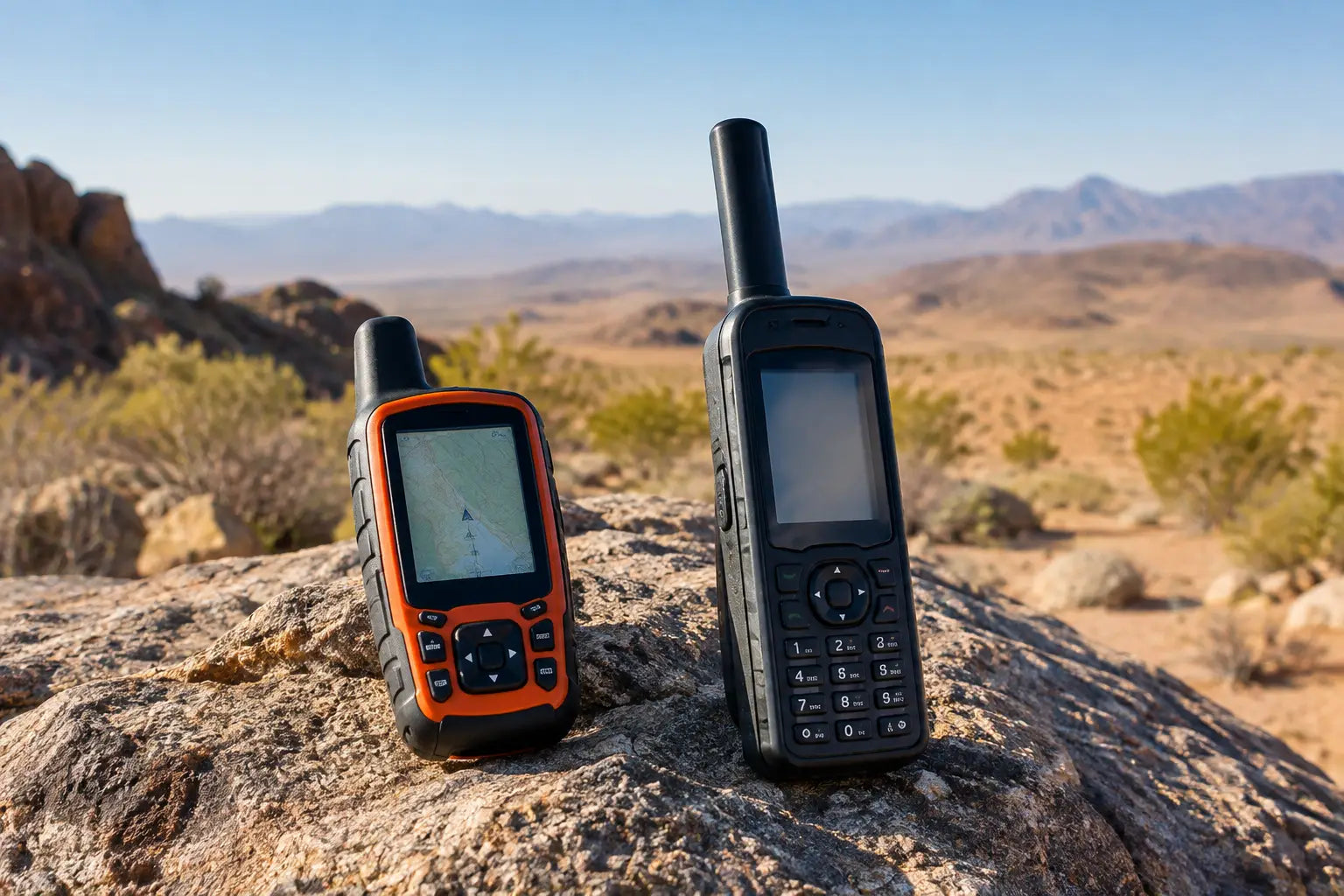
A dead cell signal outside Lake Pleasant or halfway down a two-track near the Arizona-Utah line changes the question fast: can you get a message out, or can you actually talk to someone? The gps messenger versus satellite phone decision is not about carrying the most electronics. It is about choosing the right tool for the way you travel, the people who may need to reach you, and the consequences if your vehicle, body, or route fails.
For many desert hikers, hunters, overlanders, and off-road groups, a GPS messenger is the better everyday piece of safety gear. A satellite phone earns its place when real-time voice communication matters more than size, cost, or battery runtime. Neither is a substitute for water, navigation, a paper map, recovery equipment, or a trip plan left with someone dependable.
GPS Messenger Versus Satellite Phone: The Core Difference
A GPS messenger is built for short communication and emergency location sharing. Most units can send preset check-ins, custom text messages, coordinates, tracking points, and an SOS alert through a satellite network. They are compact, usually simple to operate, and designed to stay in a pack, glove box, or chest pocket until needed.
A satellite phone works more like a regular phone, except it communicates with satellites instead of a cell tower. Its main advantage is live voice calls. If you need to explain that a driver has a possible spinal injury, describe a washed-out access road, or coordinate a tow with a contact who knows your location, speaking directly can be far more useful than sending several short messages.
That difference drives nearly every trade-off. A messenger is usually lighter, cheaper to buy, easier to keep charged, and more practical for routine check-ins. A satellite phone costs more, needs more deliberate management, and can feel oversized for a day hike. But when circumstances are complicated and changing, a voice conversation can save time and prevent misunderstandings.
When a GPS Messenger Makes More Sense
A GPS messenger fits the majority of self-reliant desert travel. If your plan is to hike, camp, hunt, run trails, or travel remote roads while checking in with family, it provides the capability you will likely use most: letting people know where you are and calling for help if things go bad.
The best use case is a situation where messages can be brief and clear. You can send a check-in from camp, tell a contact that you are delayed by a flat tire, provide coordinates after a breakdown, or trigger SOS if there is a life-threatening emergency. Many messengers also support tracking, which can give a trusted person a recent breadcrumb trail rather than forcing them to guess which road or canyon you took.
Battery life is another major advantage. Depending on settings, a dedicated messenger can run for days or longer, especially when tracking intervals are conservative. That matters in Arizona heat, where phone batteries drain faster and a long delay can turn a simple mechanical issue into an overnight problem.
Messengers also reduce the temptation to treat satellite communication like normal phone service. Their limits encourage concise updates. Before leaving pavement, build a few useful preset messages, such as "At camp, all good," "Delayed but not an emergency," and "Need pickup or vehicle assistance at these coordinates." Those messages are fast to send and easy for your contact to understand.
A messenger has limits. Text exchanges can be slow, particularly if you are trying to explain a complicated medical condition or moving recovery situation. It also requires a clear view of the sky. Deep canyon walls, heavy terrain, dense cover, and simply holding the device poorly can delay transmission. Do not wait until a true emergency to learn how your unit connects.
When a Satellite Phone Is Worth Carrying
A satellite phone is the better choice when voice communication is a real operational need, not just a nice feature. Guides, remote work crews, ranch operators, expedition teams, and people traveling far beyond reliable road access may need to make decisions with dispatchers, medical professionals, family members, or recovery contacts in real time.
Consider a multi-vehicle overland trip in a remote part of the Southwest. One vehicle suffers a serious failure, a storm has changed the route, and the group needs to decide whether to attempt a repair, send someone for help, or arrange extraction. A text thread can handle this, but it may take too long and leave too much room for confusion. A satellite phone lets one person give the whole picture in a single call.
A satellite phone can also be the stronger tool for medical incidents that are serious but not immediately an SOS situation. You may need to talk through symptoms, report changes, and receive instructions while deciding whether to self-evacuate. That does not mean a satellite phone replaces emergency services. It means you have a better way to communicate before, during, or after activating a rescue plan.
The cost is the catch. Satellite phones typically have a higher upfront price, and service plans can be more expensive than messenger plans. They are also bulkier, and talk time can drain the battery quickly. For a weekend trail ride where your main goal is an SOS button and a check-in message, that extra capability may sit unused.
Desert Conditions Change How You Should Choose
In the Southwest, heat and distance are not side details. They are part of the decision. A minor rollover, a blown tire, a missed turn, or a foot injury can become more serious when temperatures are high and the nearest pavement is hours away.
Start with how long you may be delayed. For a day hike with a known route and a responsible person monitoring your return time, a GPS messenger is usually enough. For a multi-day trip with remote roads, changing routes, older vehicles, or a small group that may split up, a satellite phone becomes more reasonable. Carrying both may be justified for extended expeditions, but only if every device has a clear purpose and someone knows how to use it.
Do not leave either device baking on a dashboard. Desert heat is hard on batteries and electronics. Keep it shaded, protected from dust, and accessible. A communicator buried under recovery straps is not much help after a crash or a hurried camp departure. Carry a compatible power bank and charging cable, but remember that a power bank left in a hot vehicle has the same heat problem.
Sky visibility matters, too. Satellite communication is not magic. Walk to an open area when safe, hold the device as instructed, and allow time for the message to send. In a slot canyon or steep wash, you may need to move before you get a clear signal. That is one more reason to communicate early rather than waiting until conditions get worse.
Choose Based on the Failure You Need to Manage
The right device follows your most likely problem. If you need a reliable way to send location, check in, and trigger SOS, buy a GPS messenger and learn it well. It is the practical choice for most hikers, hunters, campers, and off-road drivers who spend limited time beyond cell coverage.
If you regularly need to coordinate recovery, report worksite conditions, manage remote groups, or communicate through complicated emergencies, a satellite phone provides capability a messenger cannot match. The added cost makes sense when a live conversation could materially change the outcome.
Before every trip, test your device, confirm the subscription is active, update your emergency contacts, and tell someone your route, departure time, planned return, and vehicle description. Satellite gear is strongest when it supports a solid plan, not when it is expected to rescue a weak one.
The device you carry should be the one you will keep charged, keep accessible, and know how to use under stress. In desert country, that kind of readiness is worth more than a feature list.

