

Cart
0
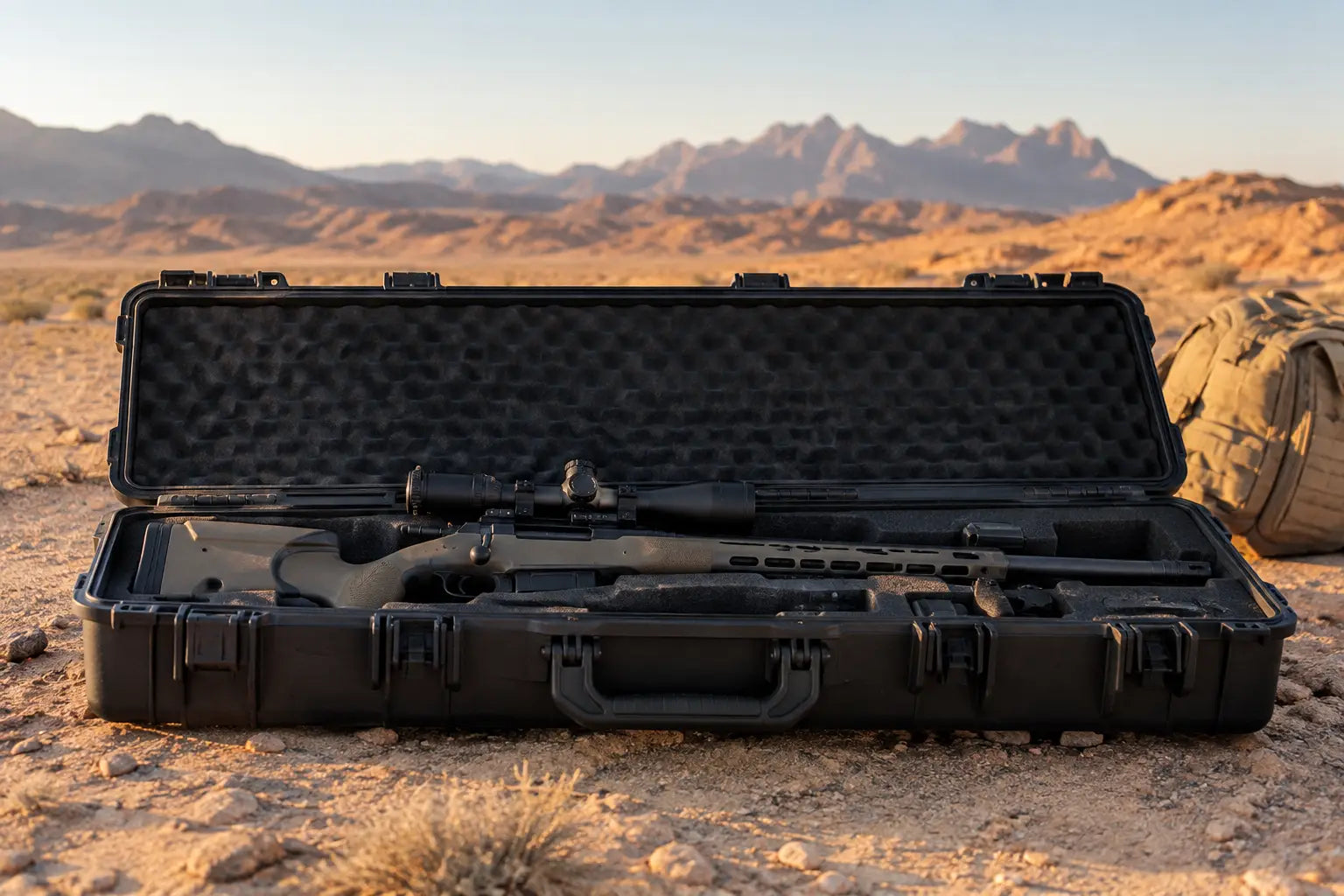
Fine desert dust does not need much of an opening. A case tossed into a truck bed, strapped to an ATV, or set down at a windy range can collect grit through weak latches, poor lid alignment, and worn seals. A dustproof rifle case gives your rifle, optic, magazines, and other field gear a controlled environment when the terrain is working against it.
For Arizona and the Southwest, that protection matters long after the drive ends. Dust on an exterior finish is one thing. Fine grit inside a scope turret, on a bolt, in a magazine well, or packed into foam can turn routine cleaning into a bigger job. The right case reduces exposure, but only if its seal, size, interior, and hardware match how you actually travel.
Why desert travel is hard on rifle cases
Desert dust is not all the same. Coarse sand can scratch surfaces and work into hinge areas. Powder-fine silt gets airborne in wind, follows vibration into small gaps, and settles everywhere. Add washboard roads, heat radiating off a vehicle, and occasional rain at higher elevations, and a basic zippered soft case starts showing its limits.
A hard case does not automatically solve the problem. Some hard cases are built mainly for stacking and impact resistance. Their lids may flex, their latches may not pull the gasket tight, and their foam may trap dirt after repeated use. For off-road travel and exposed storage, the details around the closure matter as much as the shell itself.
Dust protection also preserves the things attached to the rifle. Optics, lights, tripods, suppressor covers, and spare magazines all have surfaces and moving parts that are easier to maintain when they are not riding loose in a dust-covered vehicle. Keeping the load organized also makes it less likely that metal parts strike each other on rough roads.
What makes a dustproof rifle case work
A true dustproof rifle case uses a close-fitting lid, a continuous gasket, and latches that apply even pressure around the perimeter. Think of the gasket as the barrier and the latches as the system that makes the barrier do its job. A thick gasket is not useful if the lid can shift or if the latch tension is weak.
Start with the gasket and lid fit
Look for a gasket that runs uninterrupted around the case opening. It should sit evenly in its channel without twists, gaps, or sections that look pinched. When you close the case, the lid should meet the base squarely. If you can see uneven spacing along the seam, dust can find that weak point.
A case marketed as waterproof often provides useful dust protection as well, but read the claim carefully. Water-resistance language, a rain flap, or a rubberized edge does not necessarily mean the case has been tested for fine-particle intrusion. An ingress-protection rating can be helpful when provided, though it is only one part of the decision. Real-world latch quality, hinge construction, and proper packing still matter.
Check latch tension and hardware
Latches should close firmly without feeling flimsy or requiring excessive force. You want positive compression against the gasket, not a loose snap closure. Multiple latches spread sealing pressure across the lid, which is especially useful on longer rifle cases that may flex slightly when carried one-handed.
Metal-reinforced lock points are worthwhile for travel and vehicle storage, but locks do not make a case dustproof. They are separate functions. Also inspect the hinges. A full-length hinge pin or well-supported hinge points will better tolerate repeated opening, closing, and vibration than thin, exposed hardware.
A pressure valve is useful, with one condition
Cases with an automatic pressure-equalization valve can be practical when moving between elevations or flying. It helps prevent a tightly sealed case from becoming difficult to open after a pressure change. For desert use, the valve must be designed to equalize pressure without becoming a dirt path. A poorly made valve can defeat an otherwise solid seal.
Fit the rifle, not just the listed interior length
Measure the rifle in its actual transport setup. That means checking overall length with the stock position you use, installed optic, muzzle device or suppressor configuration where legal and appropriate, and any bipod or accessory that stays mounted. Interior length alone is not enough. The case also needs room around the rifle so foam can protect it without forcing the lid closed.
Width and depth are where many buyers get caught. A tall optic, raised turret, folding stock, pistol grip, or mounted light can make a rifle too thick for a shallow case even when its length fits. Pressure from the lid can shift a zero, stress an optic mount, or damage foam over time.
For most field setups, leave enough clearance that the rifle sits fully supported with the lid closed, but does not rattle. If the case will carry magazines, a sling, ear protection, or a compact cleaning kit, choose a layout with dedicated space. Packing loose items on top of the rifle invites rubbing and puts uneven load on the lid.
Choose foam based on how you use the case
Pick-and-pluck foam is easy to customize and works well for a rifle that stays in one configuration. Its downside is durability. Small foam cubes can tear, and exposed edges collect dust. Once the layout changes, it can be difficult to restore a clean, supportive fit.
Layered solid foam gives more flexibility if you cut it carefully, while closed-cell foam is generally better for repeated hard use. It resists moisture and abrasion better than softer open-cell material and is easier to wipe down after a dirty range day. For expensive optics or a rifle that travels often, professionally cut closed-cell foam can be worth the extra cost.
Do not cut pockets too tightly. Foam should hold the rifle in place without pressing hard on turrets, adjustment knobs, charging handles, or delicate accessories. A lid foam layer can keep the rifle from shifting, but it should contact broad, durable areas instead of putting pressure on a scope.
Heat changes the way you pack and store a case
A sealed case protects against dust, but it can also hold heat. Leaving any rifle case in direct sun or a closed vehicle for long periods is hard on optics, lubricants, batteries, polymer components, and foam. Desert temperatures inside a vehicle can climb far beyond the outside air temperature.
Use the case for transport and protection, not as permanent storage in a hot truck. When you reach camp or return home, move the case into shade or indoors as soon as practical. If the rifle was exposed to humidity changes, rain, or condensation before being sealed, open the case in a clean, dry location and let both the rifle and foam air out.
Dust is less damaging when it stays dry and loose. Dust mixed with oil, sunscreen, spilled drinks, or moisture becomes abrasive grime. Keep a small microfiber cloth and a soft brush in a separate compartment so you can clean exterior surfaces before placing the rifle back in the case.
Use a simple field check before every trip
Before loading up, inspect the gasket for cuts, sand, and flattened spots. Wipe the sealing surface clean, then close the empty case and look along the seam for uneven gaps. Open and close each latch to make sure it engages consistently. A latch that works in the garage but pops loose after miles of washboard road is not dependable.
Check that foam has not compressed to the point where the rifle can move. Shake the closed case gently. You should not hear loose accessories shifting around. Finally, inspect the exterior for cracks around handles, wheel mounts, and lock points. Those areas take the most abuse when cases are dragged across gravel or loaded into a vehicle.
When a hard case is not the best answer
A dustproof hard case is the right choice for off-road transport, long drives, airline travel where applicable, or storage in exposed environments. It is not always the best choice for a short walk to a local range or a hunt where weight and quick access matter more than maximum sealing. In those situations, a quality soft case can be more practical, as long as it is kept inside a clean vehicle and away from blowing dust.
The better approach is often to use both. Carry the rifle in a fitted hard case during vehicle travel, then use a lighter protective sleeve or soft case once you are on foot. That setup keeps the hard case from becoming an awkward extra piece of gear while still protecting the rifle during the dusty part of the trip.
A case is only as dependable as its seal and the way it is maintained. Choose one that fits your real setup, clean the gasket before dust turns into grime, and keep it out of prolonged desert heat. That routine will do more for your gear than a fancy label ever will.

